
This is the updated paragraph. Lately, ‘AI marketing automation tools‘ has become a term that has been used so often in the last few years that there is no meaning anymore behind the term. Each platform within the industry has claimed it ‘will change your workflow’ and each tool has described ‘AI technologies’ that power their product.
The Shift From ‘Automation’ to ‘Intelligence’
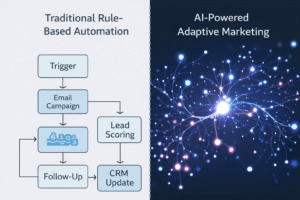
There is a significant difference between automation versus intelligence, and 2026 will be the year where that distinction can no longer be overlooked. Marketing Automation before was more about scheduling: a drip email sequence would be set up and defined by some if-then rules, that is, how it would behave. Automation historically has been efficient, however, has had limited flexibility to adapt to changes, but then an updated approach may offer new options for implementation.
The difference between technology-based solutions and AI technologies today that provide marketing applications is how those two technologies deliver their results, which will set them apart in the future. Traditional automation will be referred to as “Automation,” whereas new AI technologies will fall under the category of “Intelligence.” Traditional automation provides a fixed-output relational dataset to determine customer behavior (this includes how customers interact through email links), while AI provides customers with an evolving dataset to determine their behavior (this may include how customers use alternative products).
- The best AI marketing tools in 2026 don’t just execute your strategy — they help you discover one you didn’t know was possible.
When thinking of lead score prediction, do not just think about whether or not each lead is ‘hot’ using a human process; rather think of how AI algorithms using many different behavior signals, including page visits, email opens, and social activities, analyze every sign and update how leads are ranked dynamically. Therefore salespeople know exactly who will be first to call. Conversion rates will go up! No time will be wasted!
What AI Is Actually Doing in Marketing Right Now
1. Hyper-Personalized Content at Scale
The way we personalize content has been changing quickly. Personalization used to involve just putting a first name into an email subject line in 2024; by 2026 it will mean that all the content of the actual email (tone, product recommendations, call-to-action, even visual layout) will be dynamically generated for whoever is receiving it.
Companies such as Jasper or Copy.ai include these newer types of platforms that work off real-time CRM to deliver up to date information to help generate different images for the people receiving an email in real time and at scale. So for example, if a retailer sends emails to 500,000 customers, they won’t actually be distributing 500,000 identical emails; instead they will send 500,000 different emails, all customized to match each recipient’s purchase history, browsing patterns, and engagement history.
The outcome? Click rates and open rates are off the charts compared to what would have been thought possible just two years ago!
2. Conversational Marketing That Actually Converts
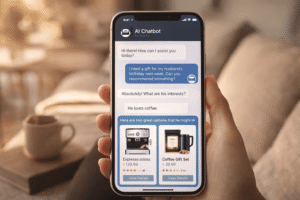
Chatbots powered by artificial intelligence have been around for a number of years; however, over the last year and now into the next, we are seeing a very impressive transformation in quality. The trend has moved from just providing users with a way to get their questions answered through a simple FAQ-type bot to providing users with intelligent sales assistants that can carry on sophisticated and context-affectual conversations – such as qualifying leads, answering in-depth questions about products or services, setting up product demos, and closing steadily equitable sales – all without the need for any assistance from a human being.
What makes this even more exciting is the addition of voice agents to the website and app experience. Companies are now beginning to use voice technology as a marketing assistant to help meet the demands of customers who prefer speaking to typing. This will also create completely new ways for organizations to engage with audiences in international markets; this is especially true in Southeast Asia and Latin America.
3. Predictive Analytics That Tell You What Happens Next
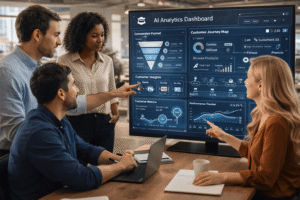
One of the most significant innovations in artificial intelligence marketing is the use of predictive analytics and customer lifetime value modelling. Marketers are no longer asking, “What happened last month?”, but rather “What will happen next month and how can we influence that?”. To do this, AI takes the historical data of past sales, combines it with current buyer behaviours and adds in other variables such as seasonal patterns or market trends to create statistical models of future buying behaviour.
Examples of how to apply this form of predictive modelling include:
- Calculating which customers are likely to stop purchasing within 30 days;
- Identifying new buyers who have a good probability of becoming repeat buyers;
- Identifying leads that have a high probability of making future purchases and only require one additional contact to complete the sale.
These are no longer guesses based on past experience or intuition; instead they are statistically-based forecasts that many of the best-marketing teams use on a daily basis to drive business results.
4. Autonomous Ad Campaign Management
For decades, paid ad campaigns have been tedious to run, having to do many time-consuming and data intensive activities including bid management, creative testing, targeting adjustments, and result analysis – all of which could take significant time daily. AI has changed this drastically.
The Human Side of AI Marketing
One thing that is lost amid all the excitement about automation is that AI doesn’t remove the necessity of human creativity and judgment; it only increases their importance.
Anyone who has ever utilized AI-generated content seriously has, at times, been frustrated by the soullessness that comes with technically correct, but not emotionally correct, outputs. The algorithms can endlessly optimize performance, but can’t create things that are original or have cultural nuance; likewise, no algorithm can create an authentic voice for a brand. Marketers who will win in 2026 will have had to learn how to use AI to accelerate their creative abilities instead of merely replacing themselves with AI.
A human’s thought process is still required when creating or assessing strategy. The understanding and reasoning behind customer behavior (i.e. emotional/socio-cultural factors that drive their decision-making) are not captured entirely by any model. AI is responsible for the heavy lifting in analytical and operational tasks associated with the best marketing campaigns of 2026; humans focus on the most important questions that arise from the activities of the customers: what do customers want to achieve? what story does our marketing program communicate? what is the brand’s identity?
- “AI handles the scale. Humans still own the meaning.”
Real-World Impact: Numbers Worth Knowing
The difference between talking about capabilities and actually observing the impacts they’re having on businesses can be measured through the data reports based on industry research collected through the 1st quarter of 2026. The statistics across industries, will amaze you.
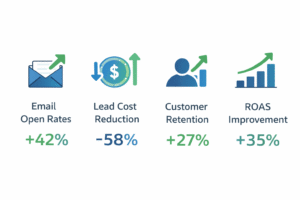
- Businesses that are utilizing AI-based personalisation for email campaigns are reporting average open rates higher than 35-50% compared to traditional segmenting.
- Companies that are using AI based chatbots to qualify leads are enjoying reductions in cost per qualified leads ranging from 35-60% within B2B environments.
- Brands that are using predictive models of churn and taking action prior to their clients churning from their business, experience an increase in customer retention rates of 20-30%.
- Companies that are using autonomous advertising management tools are observing increases in return on ad spend of 25-40% from their mature accounts that had sufficient training data.
These are not vendor case studies nor are these cherry-picked success stories; rather, the above will be regarded as a baseline number, or an emerging trend, based on industry research to determine the success of AI marketing technologies. While it is true that not every implementation achieves the numbers shown above (due largely to poor data, set up & lack of clear objective), the fact remains the top of the potential market for AI marketing is still very impressive.
What to Watch in the Next 12 Months
The rate of change continues to accelerate in all industries, and there are three trends emerging that I will recommend keeping a close eye on through 2026:
- Multimodal AIs for marketing will soon transition from the lab to the real world. The first users will soon be testing their AI-enabled marketing systems, which include real-time reporting on how video content performs across multiple platforms, and provide actionable insights into how to improve creative through changes based on viewer engagement;
- AI agents or autonomous systems that can manage marketing automation workflows without human intervention are rapidly advancing and are beginning to move into the mainstream marketplace. We are now seeing instances of agents that will research a potential client, create a customized outreach program, follow up on each response, and then update relevant CRM records, all without the direct supervision of a human being. This no longer exists only in the realm of science fiction; it currently exists as “beta” software on several different cloud-based platforms throughout the world.
- With the decline of third-party cookies globally, Privacy-First AIs are also beginning to gain traction on an international basis. As more and more brands invest in Privacy-First AI strategies, including first-party data, personalized AI on devices, and using privacy-preserving machine learning techniques, the brands that invest in a Privacy-First AI strategy will become increasingly competitive within their respective markets.
AI marketing automation in 2026 won’t replace marketers; rather, it will transform what marketing looks like and what it can do. The workload that is tactical, repetitive and data-driven will continue to be automated. On the other hand, the strategic, creative, and human-centered work is where most of the value will continue to reside.
The companies that are achieving the greatest gains from using AI marketing automation tools have some common characteristics: they have clean data, clear objectives, and marketers who comprehend both the capabilities and limitations of AI. They are not looking at AI as a magic box but rather as a fast and analytical partner in the decision-making process.
If you have not yet implemented AI into your marketing stack, then 2026 may not be a good time for you to wait; the divide between those who have early adopted AI versus those late to the game is growing. However, since the advent of new and improved technologies, there are more resourceful options available to businesses for injecting AI into their strategies than ever before.
How well can/must you utilize AI in your marketing practices?
About this article
This article was written for digital marketers, business owners, and growth professionals navigating the rapidly evolving AI marketing landscape in 2026. All statistics referenced reflect industry survey data compiled in Q1 2026.